By Scarlett Yuan
| Grade | 7-13 |
| Time | 60 minutes |
Overview:
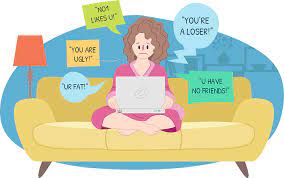
This cyberbullying lesson plan comes from mediasmarts.com and retrieved from Helping our kids deal with cyberbullying. Children are access to internet everywhere. It is benefit from the to gain more information based on their interesting, but sometime internet could become an evil place. Cyberbullying is found more happened in children. Compared with face-to-face meanness, cyberbullying make it convivence for people to potential humiliation. With the compacity of internet, children may expose to dangerous. Therefore, it is urgent to gain more information to the cyberbullying.
Learning Outcome:
- Student will be able to define and determine the behaviors of a cyberbully
- Student will be able to assess if they or their friend are being a cyberbully
- Student will be able to stand up to cyberbullying
- Student will be able to prevent and respond to the cyberbullying behavior
Curriculum Competencies:
Art Education:
– Engaging in creative expression and experiences expands people’s sense of identity and community.
-Experiencing art is a means to develop empathy for others’ perspectives and experiences.
Physical & Health Education:
-Knowing about our bodies and making healthy choices helps us look after ourselves.
-Learning about ourselves and others helps us develop a positive attitude and caring behaviours, which helps us build healthy relationships.
Communication & Collaboration:
-Students often collaborate in order to develop effective communications.
-Students engage in informal and structured conversations in which they listen, contribute, develop understanding and relationships, and learn to consider diverse perspectives
-Students engage with others in ways that build and sustain trusting relationships and contribute to collective approaches. They value diverse perspectives and integrate the ideas of others with their own to tackle tasks, issues, and problems.Students communicate in order to collaborate.
Preparation::
- Powerpoint
- Video https://youtu.be/lLzbaaC-c8o
- Handout
- Poster supplies
Learning Procedure:
| Activity | Time | Educator ‘s Job | Student’s Job | Notes |
| Assigned groups for competitions | 1mins | Assign groups for competitions, and tell students prize for winners’ group is no assignment. | Follow educator’s instructions | |
| Warm-up question | 1mins | Ask student what the behavior consider a cyberbully? | ||
| Discussion | 3mins | Ask student what the behavior consider a cyberbully? | Raised their hand to answer the answer. | Each answer for a mark. |
| Video | 5mins | Introduce the define and determine the behaviors of a cyberbully | Listen and take notes | |
| PowerPoint | 5mins | Introduce prevent or reduce the impact of cyberbullying | Listen and take notes | |
| Telephone Games | 10mins | Name one behaviors of a cyberbully, and secretly pass to a student. | Students have to pass the secret message down the line from student-to-student. The person at the end compares what they have with the original. | Which group have the original word win, and get one point. |
| Powerpoint | 5mins | Introduce ways to prevent and respond to the cyberbullying behaviors | Listen and take notes | |
| Role Play | 15mins | Give each groups 5 minutes to rehearsal a role play about prevent and respond to the cyberbullying, then ask them to present in class | Rehearsal the role play and vote for their favourite groups | Winner group get one point |
| Calculate the points | 5mins | Invite student to calculate the point together | Calculate the points | Winner group has no assignment today. |
| Handout & Assignment | 10mins | Passing the handout, and materials to make a group poster | Make a group poster |
Plan for Closure:
By making anti-cyberbullying art work, children are not only remembering the learning, but also be creative to absorb the new information. Making art work is also a good way to clam their body down, and wait for their parents to pick them up.
Comparison & Reflection:
Compared with https://www.slideshare.net/sgarza05/6-8unit3cyberbullyingcrossingtheline, we have the similar learning objects, which we acknowledge student should have the basic understanding to define and determine the behaviour of a cyberbully. Also, we all hope students are able to prevent and respond to the cyberbullying behavior at the end of the class.
On the other side, we share different format of the class. The original cyberbullying lesson plan is more like an academic lecture, which include lots of profession case study allowing student to analyze it. It is a good way for students to think critically. Focusing on a specific concept helps students to develop focus and develop their problem- solving skills.
However, my lecture is more like an experiencing lecture, providing more activities for student to immerse the topic. For my perspective, I think students are able to learn through activities. For instance, I make the whole class as a coopetition, which allow student to collaborate and to develop effective communications. While my role-play activities increase the understanding of cyberbully among student, which help them develop empathy and establish a positive values on making friend. Also, instead of using “cross line” as a at home activity, I ask student to make a poster, which could encourge their creaitivity.
To sum up, priority of making a lesson’s plan is to consider the audience, so that we could plan the course according to their ability. In this case, the original cyberbully lesson plan and mine vision share the same age group. Both lecture is educated, but I will consider the original one is more professional because they have case study for student to anylze. It is a good way for students to think critically and deeperly. While mine vision of cyberbully lesson plan are educated and entertained, which allows students to learn more than the toopic cyberbully. I think both lesson is great, as an educator, we just need to observe the student group, and see which one work better for them. Only when we make lesson plan according to student’s individualization, can really support their learning!
Reference:
BC Curriculum. Arts Education K-9 – Big Ideas. Retrieved from:https://curriculum.gov.bc.ca/sites/curriculum.gov.bc.ca/files/curriculum/continuous-views/en_arts_education_k-9_big_ideas.pdf
BC Curriculum. Physical & Health Information. Retrieved from https://curriculum.gov.bc.ca/sites/curriculum.gov.bc.ca/files/curriculum/physical-health-education/en_physical-health-education_k-9_elab.pdf
Cyberbullying Lesson Plan. Retrieved from https://www.slideshare.net/sgarza05/6-8unit3cyberbullyingcrossingtheline
N, A. (2018). Helping our kids deal with cyberbullying. Retrieved from https://mediasmarts.ca/sites/default/files/guides/guide_parents_helping_kids_deal_with_cyberbullying.pdf
 EDCI338